
 Local History
Cordelia Lewis
A Penasco pioneer · From the museum archives
When settlers first came into the Sacramento Mountains, the George W. Lewis family took up land in Lewis Canyon a few miles south of Weed, and the Jeffers family settled in Jim Lewis Canyon near the head of the Agua Chiquita. Both raised several children, and the two families intermarried so often that even they were never quite sure who was related to whom.
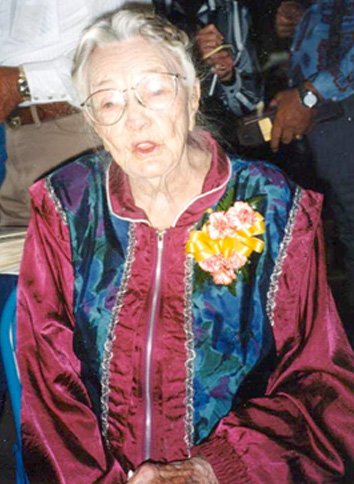
Harve Lewis married Lettia Jeffers, and Cordelia was their first child, born February 27, 1899, in the log house George Lewis had built in Lewis Canyon in 1884. The house was still standing when this story was written. Their only other child, Eldo Wafer Lewis, was born in the same house a couple of years later.
Crow Flat
Harve rode for the CA Cattle Company until the Lincoln National Forest was created and open range came to an end, taking many cowboy jobs with it. Harve and Lettia then piled their few belongings and the two children onto the running gear of a wagon and moved to Crow Flat with the Jeffers family, Lettia driving the wagon and Harve the cattle. All Cordelia recalled of the move was that her grandmother was sewing her a new dress for her sixth birthday, coming up in February 1905.
The family began in a dugout beside a shallow well. As the ranch grew they built an adobe house, John Gage and Harve drilled a 300-foot well with horse power, and Kathryn Burt Brownfield was hired to teach the several children in the area.
Cordelia loved ranch work and was a real help to her father. She and Eldo broke broncs together, Eldo taking the first rides and Cordelia finishing the job. She long treasured the praise the cowboys gave her after one big roundup, when she and her horse were in just the right spot to head off a stampede.
Ranching, she liked to say, was a long fight with a short stick. Drought around 1918 drove many ranchers, the Lewises among them, to move their cattle to Mexico, and at 19 Cordelia had no ranch work left. She went to El Paso to live with her Jeffers grandparents in their house on Trowbridge Street, which stayed in the family for many years, and took a job bunching vegetables sixty hours a week.
California and back
Restless and wanting to better herself, she wrote to the Los Angeles Chamber of Commerce about work there. The answer was encouraging enough that in 1923, at 22, she and Vera Coffelt set out for California. The two country girls had plenty of surprises in the city. The first time the ground shook, Cordelia remarked to Vera that the wind blew there just as it did in El Paso, and both were startled to learn it had been an earthquake.
She worked days and studied cosmetology at night, then landed a well-paid job at a resort that drew a wealthy clientele. When the Depression hit and business fell off, she became a manicurist at the University Men’s Social Club and saved until she could acquire a bar and grocery near Yuma, Arizona, where the post office shared the building and she served as postmaster. Things were going well until the store burned to the ground. With nothing left to rebuild, she went home to Crow Flat.
It happened to be a good year, with plenty of rain, green grass and fat stock, and the family was glad of another hand. After spring work she moved to El Paso, took a job at Fort Bliss and bought a house. When the family brought cattle to El Paso that fall, she was so struck by what they were fetching that she quit, rented out her house and went back to the ranch.
During World War II a friend who owned a beauty shop offered her work, and she moved to a town near Tinker Field, Oklahoma. Meanwhile the Army leased a large part of southern New Mexico for military use, the Lewis ranch included, and her family moved into her El Paso house. When her mother suffered a stroke soon afterward, Cordelia came back to El Paso to help care for her.
The Cash Bar in Weed
In 1947, at 48, Cordelia bought the Blue Moon Bar and Grocery in Weed and renamed it the Cash Bar and Grocery. Water had to be drawn from a cistern and the restrooms were outhouses, but she was happy to have her own business again. She worked very long hours to make it pay, kept the dance hall going and ran it with an iron hand. In 1969, at 70, she sold her liquor license to the Mescalero Apache tribe and retired. After having a well drilled and plumbing put in, she made the building into a roomy home with space for the many friends and relatives who came to visit, and she also kept a house in La Luz. For all her jobs, businesses and dealings in land and cattle, she always thought of herself first as a rancher.
At 95 she said that was a mighty long time to be around, but she had not slowed much. She traveled all over the United States and Europe, and when no one was free to go with her to a family reunion in Arizona, she drove there alone in her new car. She was especially pleased to renew her driver’s license at Cloudcroft that winter, handed to her by a granddaughter of the Cox family who had been the Lewises’ neighbors at Crow Flat in the early 1900s.
Cordelia also served her community in many ways. In the 1940s she helped bring the Rural Electric Association into the Weed and Pinon area. She sat on the Otero County Road Planning Committee for Secondary Roads, and in 1993, at 94, she was honored for her service on the Selective Service System Board during the 1940s.
In a 1985 museum interview she had wondered aloud whether she could live to the year 2000 and so span three centuries from her birth in 1899. She did. Cordelia Lewis died on September 14, 2000, at 101. At her wish there was no service; she could not bear the idea of all those people gathering without her being able to visit with them.